OpenGlob Studio
A small experiment in listening to what you write
We know this space already has strong tools.
Google’s NotebookLM, document readers, summarizers, and many other products already help people work with text. We are not trying to compete with them or replace them.
OpenGlob Studio exists for a slightly different reason.
This is an experiment to explore listening as a first class way to understand your own writing, without turning your content into something we store, analyze forever, or lock inside a system.
A clear line on content and sources
One thing we want to be very clear about from the start.
Studio does not store your uploaded sources or generated content as a knowledge base.
Your documents are used only for the moment you are working with them.
There is no long term memory of your files.
There is no dataset being built from your writing.
The goal is simple:
you bring the content, you listen to it, and you take the insight with you.
That is it.
Why audio, when text already works
Reading and listening activate different parts of how we think.
When you listen to your own writing, you often notice:
- awkward sentences you skipped while reading
- tone that feels different than intended
- missing context or rushed ideas
- clarity issues that only appear when spoken
Studio is built around this moment.
Not productivity for productivity’s sake, but reflection.
This article has an audio version too
The audio version of this article is also generated using OpenGlob Studio.
If you are reading this on blog.openglob.com, you may notice a small indicator or tooltip near the audio player showing that this narration was created inside Studio.
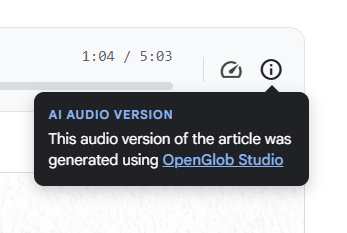
That detail is intentional.
We wanted to use the product on our own writing first.
OpenGlob blogs and internal content are the starting point.
Studio was initially built for OpenGlob’s own websites and articles, to test how audio fits naturally into long form writing.
Only after that did we decide to open it up.
How access works right now
Because this is still experimental, access is intentionally simple.
- Every new user gets 4 generations per day
- This is enough to try the flow, understand the value, and decide if it fits your use case
- If you want more flexibility, you can add your own Gemini API key, including the free tier
If you are new, you can start immediately with our daily limit.
No setup. No keys. No confusion.
This helps us keep things stable while learning how people actually use the tool.
Why limits exist
Limits are not about restriction.
They exist because we are:
- testing real usage patterns
- keeping the system fair for everyone
- rolling this out slowly instead of loudly
As we learn, these limits may change.
What makes this different from existing tools
Studio is not trying to be a research notebook, a document manager, or a source analyzer.
It is focused on one narrow experience:
turning finished or near finished writing into something you can listen to, calmly and clearly.
No dashboards.
No overload.
No aggressive features.
Just writing, voice, and understanding.
Looking ahead
This experiment may evolve in many directions.
If it works well, the intention is to keep it accessible and free, inshallah.
If it does not, we will still have learned something important about how people interact with their own words.
For now, Studio stays honest about what it is:
an experiment, shared openly, without big promises.
If you try it, your feedback matters more than usage numbers.
That is how we decide what comes next.
— The OpenGlob Team